From Democrats to Kings by Michael Scott
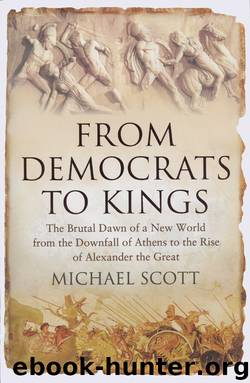
Author:Michael Scott [SCOTT, MICHAEL]
Language: eng
Format: epub
Tags: HIS000000, HIS002000, HIS002010, POL007000, POL000000
ISBN: 9781468302806
Publisher: Overlook
Published: 2012-04-20T16:00:00+00:00
CHAPTER 11
Survival Strategies
Nowhere can we see better the plentiful array of survival strategies adopted to ride out the constantly unpredictable waves of diplomatic, military, social and economic turmoil of the 4th century BC than at Athens. Athens was, after all, at the heart of much of that turmoil in the first half of the century, and the second half of the century was shaping up to place Athens in just as much trouble. The city had been through a full cycle of suffering, recovery, expectation, success and a return to failure and suffering. It had begun the century by losing its empire and its democracy. Surviving revolution and a radical reinstatement of democracy, Athens had attempted to negotiate its way, with oiled opportunism, through the political minefield of this new world. Keeping its eye firmly on its grain routes to the Black Sea and north Africa, it had attempted to work within the new world order and establish itself a new empire of sorts. But events had moved too fast, and its obstinate desire for a piece of the fertile north Aegean coast, alongside constant meddling in Asia Minor, had brought it into head-on conflict with Persia and Macedon. What was it like to be inside Athens during this time? How did the Athenian society, economy and democracy respond to the events echoing around them?
If you spoke to an Athenian businessman in the 350s BC, just as the beast of Macedon was advancing south towards Delphi, his response would be that the Athenian economy was in real trouble. Athenians relied on several different sources for their income. The first, of course, came from working the land that they owned in the territory of Attica that surrounded Athens. The second, increasingly important source of income was from manufacturing. Athens was host to a myriad of different manufacturers ranging from one-man-bands to early forms of ‘justin-time’ factories. In the beating religious, economic and political heart of the city, the Agora, which you can still wander round today in Athens, over 170 different types of goods and services could be purchased, ranging from exquisite metalwork to the cheapest of vegetables. Businesses were valued not just in terms of the goods they produced, but also for the number of slaves they owned. Demosthenes, the political orator whose name, reputation and opinions would dominate Athens’ history for the next 40 years, owed much of his family’s wealth to his father’s factories. His dad, as Demosthenes proudly recalled in one of his law court speeches, had one factory making furniture that employed twenty slaves and another, making knives, which had 33 slaves. The frank admission, and easily calculable economic value, of slave ownership reveals a basic, if unpalatable, fact about Athens. The shining, often honoured originator of democracy was a society based irrevocably on the sweat and toil of a massive slave population.
The most important, and perhaps the most problematic, source of income for Athenians was, however, trade. Perhaps half the resident population of Athens was involved in trade in one way or another.
Download
This site does not store any files on its server. We only index and link to content provided by other sites. Please contact the content providers to delete copyright contents if any and email us, we'll remove relevant links or contents immediately.
| Africa | Americas |
| Arctic & Antarctica | Asia |
| Australia & Oceania | Europe |
| Middle East | Russia |
| United States | World |
| Ancient Civilizations | Military |
| Historical Study & Educational Resources |
Room 212 by Kate Stewart(5137)
The Crown by Robert Lacey(4827)
Endurance: Shackleton's Incredible Voyage by Alfred Lansing(4796)
The Iron Duke by The Iron Duke(4372)
The Rape of Nanking by Iris Chang(4229)
Joan of Arc by Mary Gordon(4125)
Killing England by Bill O'Reilly(4015)
Say Nothing by Patrick Radden Keefe(3994)
I'll Give You the Sun by Jandy Nelson(3457)
Shadow of Night by Deborah Harkness(3383)
Hitler's Monsters by Eric Kurlander(3359)
Mary, Queen of Scots, and the Murder of Lord Darnley by Alison Weir(3220)
Blood and Sand by Alex Von Tunzelmann(3212)
Eleanor & Park by Rainbow Rowell(3193)
Darkest Hour by Anthony McCarten(3139)
Margaret Thatcher: The Autobiography by Thatcher Margaret(3093)
Book of Life by Deborah Harkness(2951)
Red Famine: Stalin's War on Ukraine by Anne Applebaum(2944)
The One Memory of Flora Banks by Emily Barr(2872)
